
1031 Exchanges on the Eastside: The Complete Investor's Guide
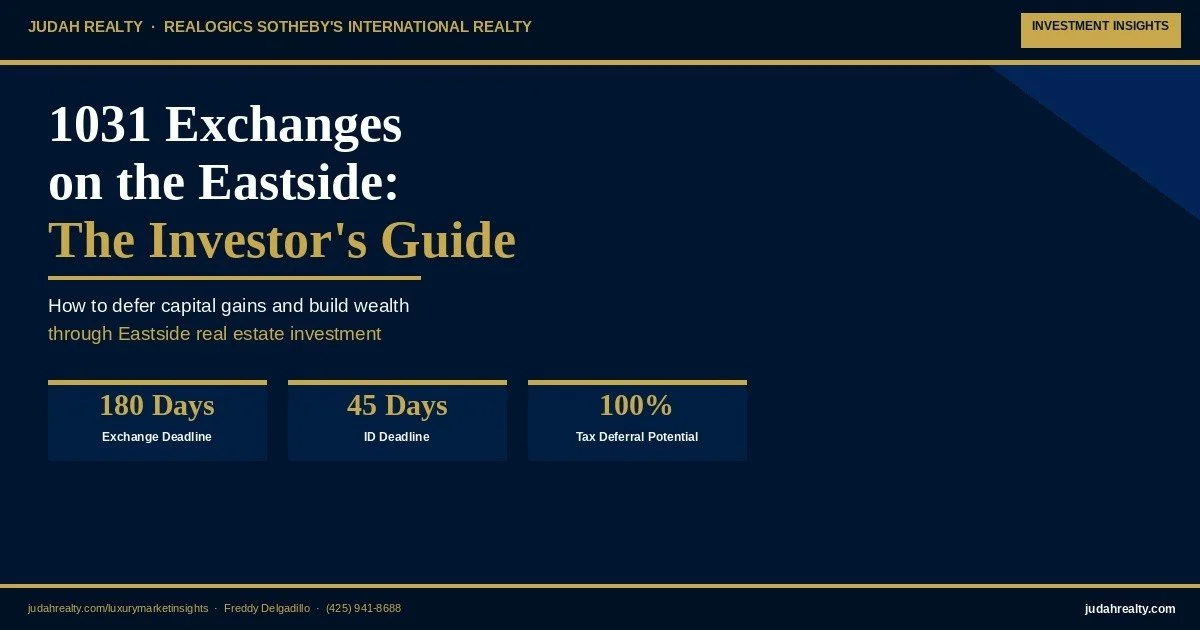
A Section 1031 like-kind exchange lets you sell an investment property and defer federal capital gains taxes entirely — as long as you identify a replacement property within 45 days and close within 180 days. On the Eastside, where investment properties have appreciated significantly, this tool can preserve hundreds of thousands of dollars in equity that would otherwise go to taxes — and redeploy it into a larger, higher-performing asset.
If you own an investment property on the Eastside — a rental home, a duplex, a multi-family building, or a commercial property — and you've been thinking about selling, one number probably keeps you from pulling the trigger: the capital gains tax bill. For a property that's appreciated significantly over the past decade, that bill can reach six figures or more in federal and state taxes, eliminating a substantial portion of your sale proceeds before you ever see them.
A Section 1031 like-kind exchange is the IRS-authorized mechanism that allows you to defer that tax bill — legally and entirely — by rolling your proceeds directly into another qualifying investment property. It is one of the most powerful wealth-building tools in real estate, and it is underused by investors who don't fully understand how it works or don't have an advisor who can help coordinate the timing.
This guide explains exactly how a 1031 exchange works, what the rules are, what the timeline looks like, and specifically how to think about it in the context of the Eastside market in 2026.
⚖️ Important Disclosure
This guide is educational and informational. A 1031 exchange involves complex IRS rules and tax implications that vary by individual situation. Always consult a qualified tax advisor, CPA, or attorney before proceeding with a 1031 exchange. Freddy Delgadillo and Judah Realty are real estate advisors, not tax professionals.
What Is a 1031 Exchange,
In Plain English?
Section 1031 of the Internal Revenue Code states that if you exchange one investment property for another "like-kind" investment property, you can defer recognition of the capital gain from the sale. "Defer" means you don't pay the tax now — you roll it forward into your new property. You only pay when you eventually sell that new property without doing another exchange.
Here is why this is powerful: let's say you purchased a rental home in Redmond for $600,000 in 2015. It's now worth $1,400,000. If you sold it outright, you'd owe capital gains tax on approximately $800,000 of profit — potentially $180,000–$240,000 in federal taxes depending on your income bracket, plus Washington's new capital gains tax on gains above $262,000. A 1031 exchange lets you take that full $1,400,000 and roll it into a new investment property, deferring that entire tax bill and letting your full equity continue compounding.
Importantly, you can do this repeatedly. Each time you exchange, the tax defers forward. This is how sophisticated real estate investors build significant portfolios over time — by never triggering the tax, they let compounding work on the full asset value rather than the after-tax remainder.
The Rules You Must Follow:
Four Non-Negotiables
Rule 1: Like-Kind Property
IRS RequirementBoth the property you sell (the "relinquished property") and the property you buy (the "replacement property") must be held for investment or business use. They don't need to be identical — you can exchange a single-family rental for a multi-family building, a duplex for commercial real estate, or an Eastside property for real estate in another state. What doesn't qualify: your primary residence, a vacation home used primarily for personal use, or property held primarily for sale (like a flip).
Rule 2: Qualified Intermediary Required
CriticalYou cannot touch the sale proceeds. The moment the money hits your bank account, the exchange is disqualified. All proceeds from your sale must be held by a Qualified Intermediary (QI) — a neutral third party who holds the funds between the sale and the purchase. Your QI must be established before your sale closes. Your attorney, your real estate agent, and your accountant cannot serve as your QI. You must engage a separate, dedicated QI early in the process — ideally before you list your property for sale.
Rule 3: Equal or Greater Value
To Defer 100%To defer 100% of your capital gains tax, your replacement property must be of equal or greater value than your relinquished property, and you must reinvest all of the equity (not just some of it). If you purchase a replacement property of lesser value or pull some cash out of the exchange, the portion not reinvested — called "boot" — is taxable in the year of the exchange. Partial deferral is still valuable, but full deferral requires full reinvestment.
Rule 4: The Two Deadlines
Hard IRS DeadlinesTwo calendar deadlines govern every 1031 exchange, and neither can be extended under normal circumstances. 45 days from your sale closing — you must formally identify your replacement property in writing. 180 days from your sale closing (or by the due date of your federal tax return, whichever is earlier) — you must close on your replacement property. Miss either deadline and the exchange fails, triggering full capital gains tax in the year of sale.
The 1031 Exchange Timeline:
Day by Day
Understanding the sequence matters as much as understanding the rules. Here is exactly what happens, and when, from the moment you accept an offer on your investment property.
1031 Exchange Strategy
on the Eastside in 2026
The current Eastside market creates specific 1031 exchange considerations that differ from a rising market. As covered in the May 2026 NWMLS market update, inventory is rising and the market is shifting toward balance in several submarkets. For investors, this creates both an opportunity and a timing consideration.
Eastside Submarkets Worth Targeting as Replacement Properties
The strongest 1031 replacement property targets on the Eastside in 2026 are markets with structural supply constraints that support long-term rental demand — regardless of short-term market softening at the macro level.
Issaquah / Newcastle
2.63 months supply. DOM 13 days. $1,625,000 median. Tight inventory, fast absorption, strong school district driving sustained family rental demand.
East Bellevue
3.27 months supply. $1,650,000 median. Tech-corridor location with Microsoft and Amazon proximity sustaining a deep, qualified renter pool.
Bothell / Canyon Park
2.40 months supply — fastest absorption on the Eastside. $1,145,000 median. Lower acquisition cost with strong rental demand from the tech and healthcare corridor.
Eastside Waterfront
Structurally scarce inventory regardless of market cycle. Best for appreciation-driven investors with longer hold horizons and access to the $3M–$10M+ segment.
Market data from the Northwest Multiple Listing Service, April 2026. Information and statistics compiled and reported by the Northwest Multiple Listing Service.
The Timing Consideration in a Shifting Market
One nuance that matters in 2026 specifically: the 45-day identification window assumes you know what you want to buy before you sell. In a market with rising inventory and more choices than a year ago, this is actually a more comfortable environment for 1031 investors than a low-inventory, fast-moving market where replacement properties disappear in days.
The caution is on the sell side. If you're selling an investment property in a submarket that's softened — like West Bellevue at 8.41 months of supply, as documented in the seller advisory guide — be realistic about your pricing timeline. A delayed sale can compress your 45-day identification window uncomfortably if you're counting on a specific close date.
Washington State Capital Gains Tax — A New Consideration
Washington state enacted a capital gains tax effective 2023, applying a 7% tax on long-term capital gains above $262,000. This is in addition to federal capital gains tax. A successful 1031 exchange defers federal capital gains tax, but Washington's capital gains tax treatment of 1031 exchanges is a separate analysis your CPA must address. This makes the tax planning conversation even more important for Eastside investors than it was in prior years — the combined tax exposure from a large gain is now meaningfully higher.
What Your Purchase Contract
Says About 1031 Exchanges
If you're purchasing a replacement property on the Eastside, the NWMLS Residential Purchase and Sale Agreement (Form 21) actually contains a specific 1031 provision worth knowing. General Term G states that if either buyer or seller intends this transaction to be part of a Section 1031 like-kind exchange, the other party shall cooperate in completing the exchange — as long as they don't incur additional liability, and any exchange-related expenses are paid by the party completing the exchange.
This means you can disclose your 1031 exchange intent to the seller without fear of jeopardizing your offer — the contract explicitly contemplates it. It also means you can assign your purchase contract to your Qualified Intermediary as part of the exchange structure, as authorized in the same section of Form 21.
Frequently Asked Questions:
1031 Exchanges and Eastside Real Estate
How does a 1031 exchange work in real estate?
A Section 1031 like-kind exchange allows a real estate investor to sell an investment property and defer federal capital gains taxes by reinvesting the proceeds into another qualifying investment property. You must identify a replacement property within 45 days of your sale and close within 180 days. All proceeds must flow through a Qualified Intermediary — you cannot touch the money personally. Properties must be held for investment or business use.
What is the 45-day rule in a 1031 exchange?
Within 45 calendar days of closing on your relinquished property, you must formally identify in writing the replacement property or properties you intend to purchase. You can identify up to three properties regardless of value. The 45-day clock starts the day you close on your sold property and cannot be extended — it is a hard IRS deadline with no exceptions under normal circumstances.
What is the 180-day rule in a 1031 exchange?
You must close on your replacement property within 180 calendar days of closing on your relinquished property — or by the due date of your federal tax return for the year of the sale, whichever comes first. If your return is due before day 180, you may need to file for an extension to preserve the full window. This deadline is also hard and cannot be extended under normal circumstances.
Can you do a 1031 exchange on an Eastside rental property?
Yes. An Eastside rental property — whether a single-family rental, duplex, or multi-family property — qualifies for a 1031 exchange if it has been held for investment purposes. Washington state does not impose additional 1031 exchange rules beyond federal IRS requirements. You can exchange into a property anywhere in the United States, and vice versa.
What Eastside properties make good 1031 exchange targets?
Strong 1031 replacement targets on the Eastside in 2026 include multi-family properties in tight-supply submarkets like Issaquah, Bothell, and East Bellevue where rental demand is sustained by tech-corridor employment, ADU-eligible single-family properties taking advantage of Washington's zoning reforms, and waterfront investment properties for appreciation-driven investors with longer hold horizons. The right target depends on your investment objectives — income, appreciation, or both.

Freddy Delgadillo
Luxury Real Estate Advisor · Realogics Sotheby's International Realty
🏆 500+ Transactions · 25+ Years on the Eastside
🎓 CLHMS · ABR® · CRS · GRI · CSP
🌐 Servicios en Español Disponibles
🏛️ Board Trustee · Northwest University
A 1031 Exchange Works Best When the Real Estate Decision and the Tax Strategy Move Together.
I've helped investors navigate the Eastside market through multiple cycles — and the ones who build real wealth do it by letting their equity keep compounding rather than handing a significant share to the IRS at every sale. If you're holding an Eastside investment property with significant appreciation and wondering whether now is the right time to make a move, let's have that conversation. I'll bring the market analysis. You bring your goals. We'll figure out the right next step together.
freddy@judahrealty.com · (425) 941-8688
10237 Main Street, Bellevue WA 98004