
The Hidden Costs of Owning Eastside Waterfront Property
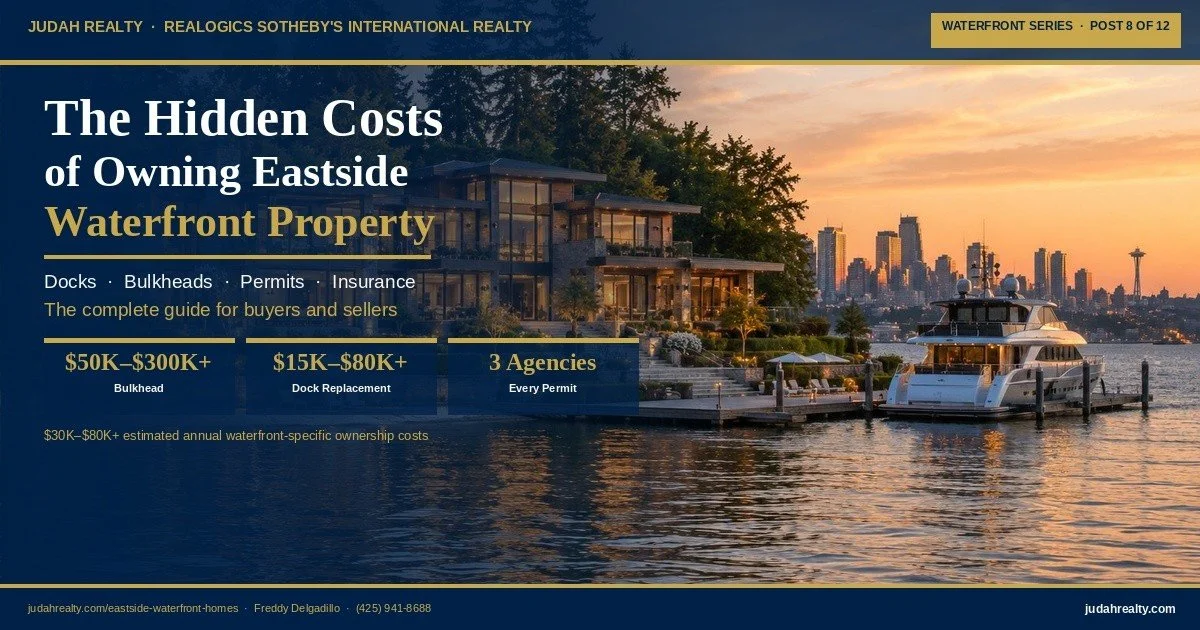
The listing price on an Eastside waterfront home is only the beginning of the financial conversation. What most buyers — and even many agents — do not fully account for is the layer of ongoing, waterfront-specific costs that arrive after closing: the dock that needs replacing, the bulkhead that requires a geotechnical engineer, the shoreline permit that takes fourteen months and costs more than the buyer expected, the insurance premium that is 50% higher than their inland comparison.
This post is not meant to discourage you from buying waterfront property on the Eastside. The lifestyle, the privacy, the long-term value — these are real and they are significant. What this post is meant to do is make sure you go into the purchase with complete information, not pleasant surprises. The buyers who are happiest in their waterfront homes five years after closing are the ones who understood the full cost picture before they made the offer.
And if you are a waterfront seller reading this — this post shows you exactly what your buyer's due diligence will look like. In a market with more inventory and selective buyers, understanding these pressure points before you list puts you in a position of strength, not defense. Both audiences will find what they need here.
Why Waterfront Costs Are
Fundamentally Different
When you buy an inland luxury home on the Eastside, your ongoing cost structure is relatively predictable: property taxes, HOA fees if applicable, standard homeowners insurance, and routine maintenance. You are operating in a single regulatory environment — your city or county.
When you buy waterfront, everything changes. You are now the owner of a shoreline — and that shoreline exists at the intersection of federal, state, and local jurisdiction simultaneously. Anything you want to do to the waterfront portion of your property — repair a dock, replace a bulkhead, add a boat lift, stabilize erosion — requires navigating all three.
Federal
U.S. Army Corps of Engineers · Section 404 & Section 10 Clean Water Act · Required for any work in or over navigable waters
State
WA Dept. of Ecology · Shoreline Management Act · Hydraulic Project Approval (HPA) from WA Dept. of Fish & Wildlife
Local
King County or applicable city · Shoreline Master Program · Building permits · Critical area regulations
This triple-jurisdiction reality is the single most important thing to understand about waterfront ownership before you buy. It is not a barrier to ownership — millions of people own waterfront properties in Washington and navigate this successfully. But it means that what would be a $5,000 repair on an inland home can become a $30,000 permitted project on a waterfront property. Timeline expectations must also adjust: permits for shoreline work commonly take 6–18 months from application to approval.
The Annual Cost Stack:
What the Numbers Actually Look Like
The chart below illustrates a realistic range of annual waterfront-specific ownership costs across all seven categories covered in this post. These figures are separate from standard homeownership expenses — mortgage, property taxes, utilities, and general maintenance. This is the waterfront premium layer on top of all of that.
Annual Waterfront-Specific Ownership Costs — Conservative vs. High Estimate
Annual cost estimates based on typical Eastside waterfront property ownership. Individual costs vary significantly based on property size, structure age, condition, and specific location. Figures represent annual recurring costs and do not include major one-time replacement events.
Estimated Annual Waterfront-Specific Ownership Costs
This range sits on top of standard homeownership expenses — mortgage, property taxes, utilities, and general maintenance. On a $5M waterfront purchase, the waterfront premium layer adds 0.6%–1.6% in additional annual carrying costs. Understand this number before you negotiate the purchase price.
The 7 Hidden Cost Categories:
What Every Waterfront Buyer Needs to Know
1. Dock Ownership, Maintenance & Replacement
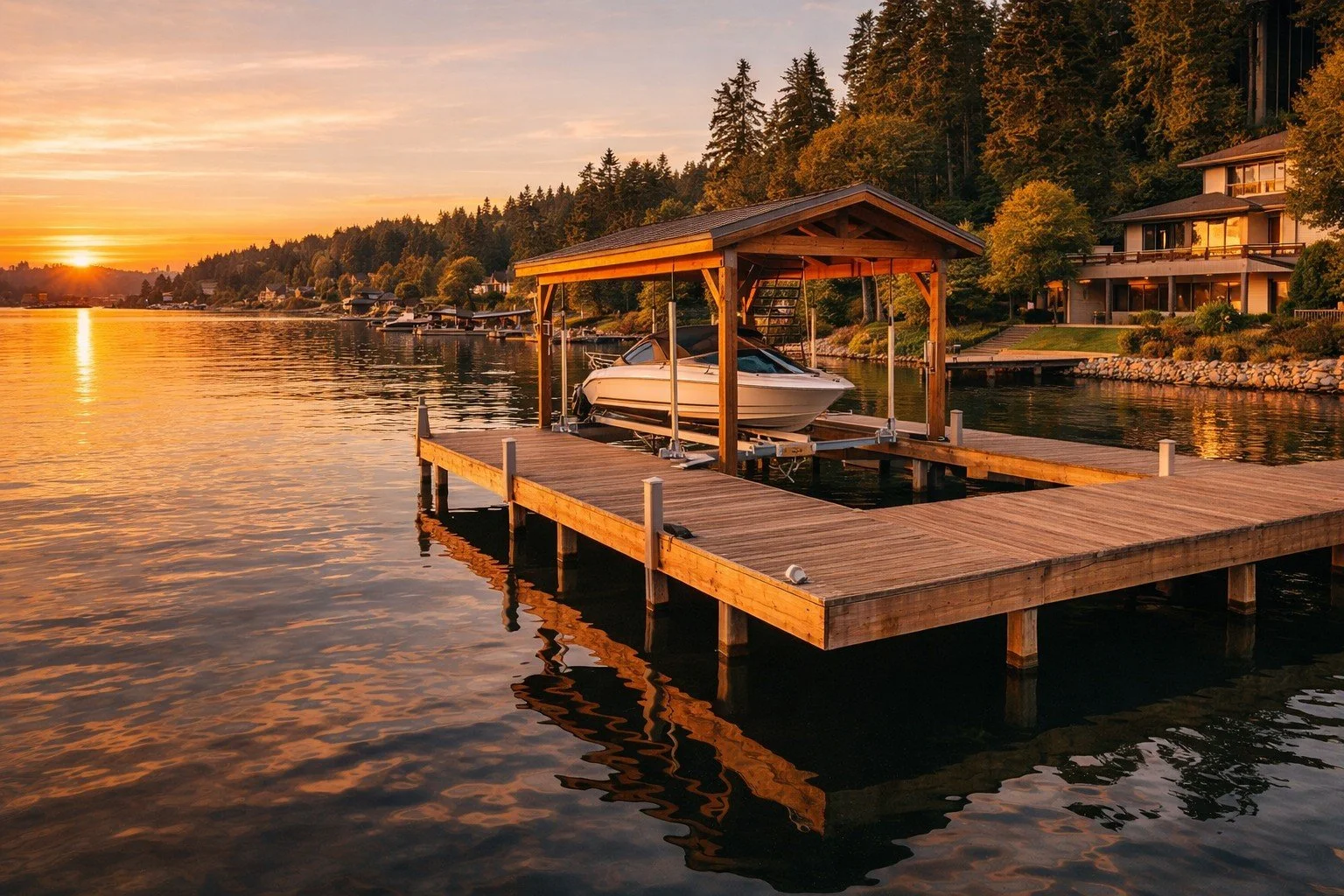
$2K–$8K/yr · $15K–$80K+ replacementThe dock is one of the most visible features of any waterfront property — and one of the most commonly misunderstood from a cost perspective. Buyers see a dock and assume it is simply there, maintained, and ready to use. What they often do not ask is: How old is it? When was it last inspected? What is the structural condition of the pilings? Is the electrical system up to code?
Annual dock maintenance — routine inspections, hardware replacement, minor repairs, and seasonal preparation — runs $2,000–$8,000 depending on dock size and complexity. When a dock reaches the end of its useful life, replacement costs range from $15,000 for a basic floating dock to $80,000 or more for a large covered slip with boat lifts and full electrical systems. On Lake Washington specifically, dock replacement also triggers the full permit process described in the next section.
Freddy's Note: Always ask for the dock's age and last inspection report during due diligence. A dock approaching 20–30 years of age — even if it looks fine visually — may be 2–3 years away from a major capital expense. Factor that into your offer price, not your first-year budget.
2. Shoreline Permits & Regulatory Compliance
$5K–$25K+ for permits aloneAs outlined above, any modification to waterfront structures on the Eastside requires simultaneous approval from federal, state, and local agencies. The permit costs themselves — not the construction — can run $5,000–$25,000 or more depending on project scope and the agencies involved. Timeline expectations matter equally: from application to approval, shoreline permits commonly take 6 to 18 months.
This has two practical implications for buyers. First, if you intend to modify the dock, add a boat lift, or address a bulkhead shortly after purchase, build permit costs and timeline into your planning — not as an afterthought. Second, check the permit history of existing structures before you close. Unpermitted work on a waterfront property is a liability that transfers with the deed.
Freddy's Note: I always recommend requesting a full permit history pull from King County and the applicable city as part of waterfront due diligence. Unpermitted shoreline structures are more common than buyers expect — and they become your problem the moment you close.
3. Bulkhead Inspection, Repair & Replacement
$50K–$300K+ depending on footageA bulkhead is the retaining wall along your waterfront property line that holds back soil and prevents shoreline erosion into the lake. On Eastside waterfront properties, bulkheads are constructed of concrete, steel sheet pile, or treated timber — each with its own lifespan, maintenance profile, and replacement cost structure.
Bulkhead replacement is the single largest potential capital expense in waterfront ownership. Cost is driven by linear footage: a typical Eastside waterfront lot may have 50–150 feet of shoreline. At $500–$2,000+ per linear foot depending on material choice, access conditions, and permit requirements, total replacement costs commonly range from $50,000 to $300,000 or more. A failing bulkhead is not optional to address — it is a structural and regulatory obligation.
Freddy's Note: Never skip a bulkhead inspection, even on a newer home. Bulkhead failure is often not visible at the surface. A licensed geotechnical or marine engineer — not a general home inspector — is the right professional for this specific inspection. The cost of the inspection is trivial relative to what it can reveal.
4. Waterfront-Specific Insurance Premiums
30–60% higher than comparable inland homeMost buyers obtain insurance quotes based on homes they have owned before — typically inland properties. Waterfront homeowners insurance is a different product. Premiums are driven by dock liability coverage, elevated replacement cost valuations for waterfront structures, flood zone considerations based on the specific property's elevation and FEMA designation, and watercraft liability if a boat is moored at the property.
Some insurers also require separate marine insurance policies for docks and boat lifts as independent structures. For a $4M–$6M Eastside waterfront home, the difference between inland and waterfront insurance can be $8,000–$20,000 per year in additional premium. Obtain insurance quotes before you remove contingencies — not after.
Freddy's Note: Certain properties in specific shoreline designations or flood zones can be difficult to insure at standard rates. I recommend initiating the insurance conversation within the first week of the due diligence period so you have time to shop carriers if the first quote is unexpected.
5. Lake & Waterway Association Fees
$2K–$15K per yearMany Eastside waterfront communities — particularly along Lake Washington — have mandatory lake or waterway associations that govern shared shoreline access, dock use, water quality programs, and community infrastructure. These are not optional HOAs in the traditional sense. They are often tied to riparian rights and shoreline access agreements that are recorded against the property.
Annual fees range from $2,000 in smaller associations to $15,000 or more in communities with extensive shared amenities or complex waterway management programs. Some communities also levy special assessments for major shared infrastructure projects — bulkhead repairs on shared shoreline, dredging programs, or dock replacement in common areas. These assessments can be significant and are rarely predictable in advance.
Freddy's Note: Request the full association disclosure package — including the last three years of meeting minutes and financial statements — during due diligence. Meeting minutes are where you will find discussion of pending special assessments before they become line items on your closing statement.
6. Erosion Control & Shoreline Landscaping
$3K–$20K per year ongoingShoreline erosion is a persistent and relentless reality of waterfront ownership in the Pacific Northwest. Wave action, seasonal lake level fluctuations, boat wake, and rainfall runoff all contribute to ongoing erosion pressure against your waterfront property. North-facing exposures on Lake Washington — which receive less sun and have higher exposure to prevailing winds — tend to experience the most significant erosion rates.
Ongoing erosion control — rock armor, native plantings, root mat establishment, and periodic regrading — is an annual expense that many buyers do not anticipate. For properties with significant shoreline exposure, annual erosion management costs of $5,000–$20,000 are realistic. Properties with well-established native vegetation buffers and properly armored shorelines incur lower costs — another item to evaluate during due diligence.
Freddy's Note: Washington state and King County both encourage native vegetation buffers along shorelines as erosion control — and both also regulate what you can plant and remove within the shoreline jurisdiction zone. Before you landscape your new waterfront property, confirm what is and is not permitted under your local Shoreline Master Program.
7. Watercraft Storage, Moorage & Maintenance
$3K–$25K per yearThis is the cost category buyers most commonly underestimate — because it is the most optional-seeming. You have a dock. Of course you will have a boat. That boat, once acquired, carries its own annual cost structure that is entirely separate from the home: moorage fees if the dock capacity is limited, boat storage during off-season, annual maintenance, insurance, fuel, and registration.
For buyers purchasing on Lake Washington or Lake Sammamish with an existing dock, watercraft costs are worth building into the total ownership budget from day one — even if boat ownership is aspirational rather than immediate. The lifestyle that makes waterfront ownership worth the premium is most fully realized when the dock is actually being used.
Freddy's Note: Confirm that the existing dock is rated for the size and type of watercraft you intend to moor. A dock built for a runabout may not support a larger cruiser. Boat lift capacity, electrical capacity, and dock clearance are all specification items to verify before purchase — not after you've already bought the boat.
Pre-Purchase Due Diligence:
10 Things to Verify Before You Make an Offer
This checklist is the most actionable takeaway in this post. Save it, share it with your attorney, and bring it to every waterfront property showing you attend. An experienced waterfront advisor should be coordinating every one of these items during your due diligence period — not you, alone, after closing.
- Dock inspection by a licensed marine engineer — structural integrity, electrical systems, boat lift condition, age estimate, remaining useful life
- Bulkhead inspection by a geotechnical or marine engineer — not a general home inspector; this requires a specialist with shoreline experience
- Full permit history pull — King County + applicable city; confirm all shoreline structures are permitted; flag any unpermitted work for negotiation
- Shoreline Management Act review — identify restrictions on future modifications to the waterfront portion of the property
- FEMA flood zone determination — obtain the official FEMA designation for the specific parcel and estimate insurance cost accordingly
- Insurance quotes from minimum two carriers — obtained during due diligence period, before contingency removal; include dock and watercraft liability in the quote scope
- Lake or waterway association disclosure package — three years of meeting minutes, current fee schedule, pending assessments, and CC&Rs if applicable
- Shoreline easement review — confirm whether any public access easements, neighbor access rights, or utility easements cross the waterfront portion of the property
- Erosion history and current condition assessment — ask the seller to disclose any erosion-related repairs or stabilization work in the last 10 years
- Dock and watercraft specifications match — confirm dock rating, boat lift capacity, and electrical capacity are compatible with your intended use

What Thriving Waterfront
Ownership Actually Looks Like
Everything in this post exists to prepare you — not to discourage you. The buyers and owners who thrive in Eastside waterfront properties are not the ones who avoided these costs. They are the ones who understood them, planned for them, and found advisors who helped them navigate every layer of complexity before it became a problem.
Waterfront ownership on Lake Washington or Lake Sammamish is a long-term decision. The views do not depreciate. The lifestyle does not diminish. The scarcity of available waterfront on the Eastside — a finite shoreline serving one of the country's most economically dynamic metro areas — creates structural long-term value that holds through multiple market cycles. What changes is your experience of that ownership: buyers who went in eyes open look back on their waterfront purchase as one of the best decisions they ever made. Buyers who were surprised by costs they did not anticipate tend to feel differently.
The current Eastside market — as covered in the May 2026 NWMLS Market Update — is seeing growing inventory and more selective buyers. In this environment, waterfront sellers who have maintained their properties well and can demonstrate a clean permit history, recent dock inspection, and sound bulkhead have a measurable competitive advantage over properties that leave buyers guessing. And waterfront buyers have more negotiating room than they have seen in years — which means the due diligence period is more valuable than ever.
For context on what waterfront properties are trading for right now — and what different price tiers deliver in terms of waterfront features and condition — the complete guide to what $5M, $10M, and $20M buys in Eastside waterfront is the right companion read. And for the full series — from market comparisons to buyer education — the Eastside Waterfront Homes hub has every post organized in one place.
Additional reading from this series: the Opening Day 2026 waterfront market analysis covers seasonal activity patterns, and the city-specific waterfront guides for Mercer Island, Bellevue, and Kirkland provide the hyperlocal detail behind each submarket's waterfront characteristics.
Frequently Asked Questions:
Eastside Waterfront Property Costs
How much does it cost to maintain a dock on Lake Washington?
Annual dock maintenance on Lake Washington typically runs $2,000–$8,000 for routine upkeep including inspections, minor repairs, hardware replacement, and seasonal preparation. Full dock replacement — necessary every 20–40 years depending on materials and construction — ranges from $15,000 for a basic floating dock to $80,000 or more for a large covered structure with boat lifts. Buyers should always request the dock's age, last inspection date, and repair history before making an offer.
Do I need a permit to modify a dock in Washington state?
Yes. Any modification, replacement, or new construction of a dock on Lake Washington or Lake Sammamish requires permits from multiple agencies simultaneously: the Washington State Department of Ecology under the Shoreline Management Act, the U.S. Army Corps of Engineers under the Clean Water Act, and King County or the applicable city government. Permit timelines commonly run 6–18 months and costs can reach $5,000–$25,000 or more before any construction begins.
What is a bulkhead and why is it so expensive to replace?
A bulkhead is a retaining wall along the waterfront property line that holds back soil and prevents the shoreline from eroding into the lake. Replacement cost is driven by linear footage — a typical Eastside lot may have 50–150 feet of shoreline. At $500–$2,000+ per linear foot depending on material and access conditions, total replacement commonly ranges from $50,000 to $300,000 or more. A licensed geotechnical or marine engineer — not a general home inspector — is the right professional for a bulkhead assessment.
How much more is homeowners insurance for a waterfront property on the Eastside?
Waterfront homeowners insurance on the Eastside typically runs 30–60% higher than a comparable inland home. The premium increase reflects dock liability coverage, higher replacement valuations for waterfront structures, flood zone considerations, and watercraft liability. For a $4M–$6M Eastside waterfront home, the annual waterfront insurance premium difference can be $8,000–$20,000 above inland equivalents. Obtain insurance quotes before removing contingencies — not after closing.
What should a seller do before listing a waterfront home on the Eastside?
In a market with growing inventory and selective buyers, waterfront sellers who prepare proactively have a measurable advantage. The most impactful pre-listing steps are: commission a dock and bulkhead inspection and address any flagged issues before buyers see them; pull and organize your permit history so you can demonstrate clean compliance; obtain a current insurance renewal quote to share with prospective buyers as a baseline; and review your lake association financials for any pending assessments that should be disclosed. A buyer who sees documented, clean waterfront infrastructure writes stronger offers with fewer contingencies.

Freddy Delgadillo
Luxury Real Estate Advisor · Realogics Sotheby's International Realty
For Waterfront Buyers
Know What You're Buying Before You Fall in Love With It.
Twenty-five years on the Eastside means I have seen every version of this due diligence conversation — the ones that happened before closing and the ones that happened after. The difference in outcome is significant. If you are researching an Eastside waterfront purchase, I want to walk through the property-specific questions with you before you make an offer: dock condition, permit history, bulkhead status, insurance, association obligations. That conversation is free. The surprises you avoid are not.
For Waterfront Sellers
Your Buyer Will Ask Every Question in This Post. Let's Get Ahead of Them.
In today's market — more inventory, more selective buyers — the waterfront homes that close cleanly are the ones where the seller already has the answers. Dock inspection on file. Permit history organized. Bulkhead documented. Insurance straightforward. If you are thinking about listing your Eastside waterfront property, the pre-listing conversation is where we turn your property's story into a competitive advantage. Let's talk about your specific situation before we talk about price.
ABR® · Accredited Buyer's Representative | CRS · Certified Residential Specialist | GRI · Graduate REALTOR® Institute | CLHMS · Certified Luxury Home Marketing Specialist