
Eastside Waterfront Dock Rights & Permitting Guide
⚓ Eastside Waterfront Series · Post 10 of 12
A year-long authority campaign covering every dimension of Eastside waterfront real estate. View the full series →
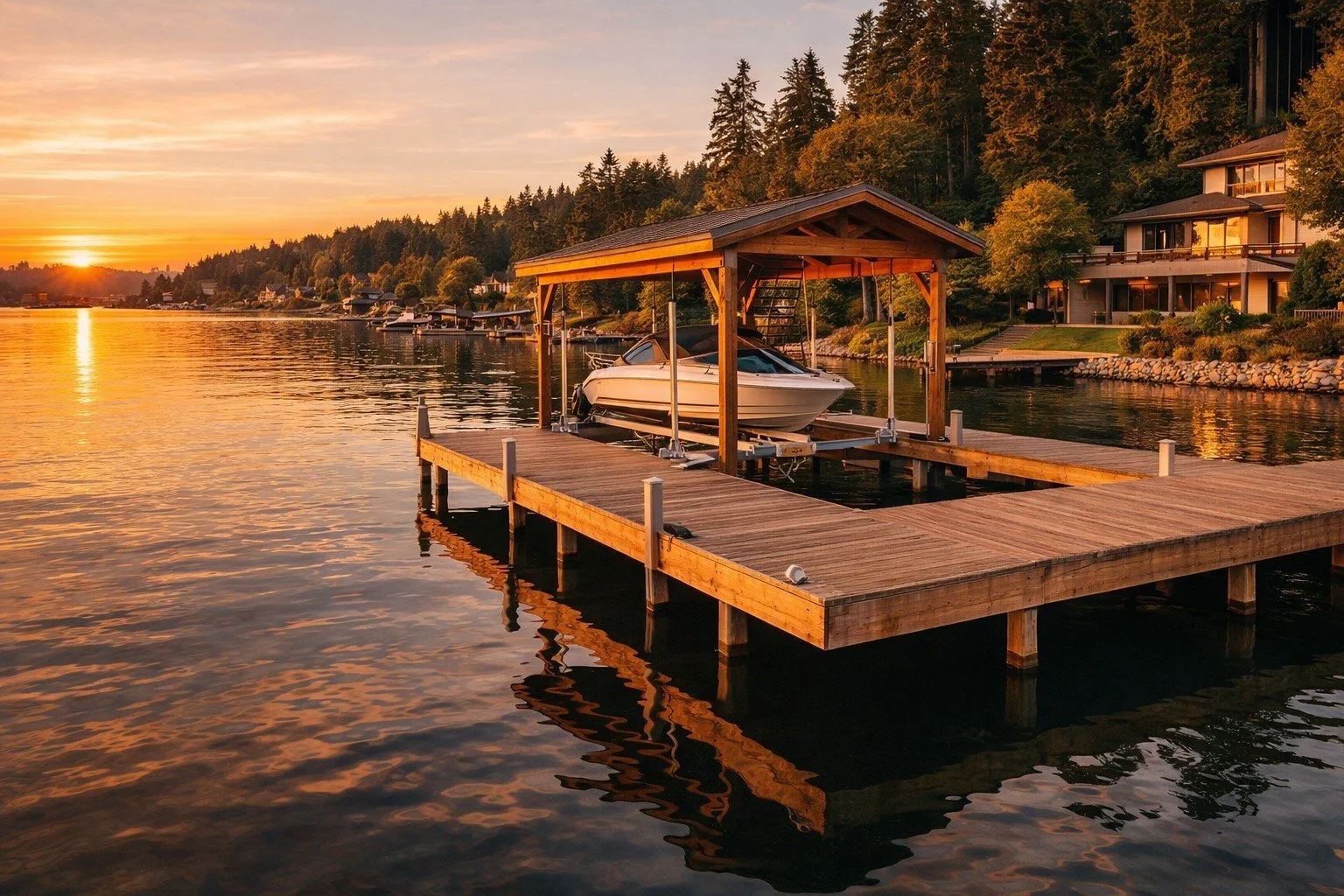
Getting a private dock on Eastside waterfront isn't guaranteed — it depends entirely on your lot. Low-bank and no-bank waterfront properties can typically support a private dock through a layered permitting process involving the Army Corps of Engineers, Washington State shoreline permits, local building permits, and HOA approval. High-bank properties usually can't. Expect $50,000–$200,000+ in installation costs, and understand that a property with an existing permitted dock carries real value because it eliminates years of uncertainty for the next owner.
The Question Every Waterfront Buyer Forgets to Ask
Most waterfront buyers fall in love with the view and assume the dock — existing or future — comes with the territory. It doesn't. Dock rights are property-specific, shaped by shoreline type, jurisdiction, environmental regulation, and sometimes decades-old permitting history that has nothing to do with the current owner's intentions. I've watched buyers write offers on stunning Eastside waterfront lots assuming they could add a private dock, only to discover during due diligence that the shoreline type or local regulations made it impossible — or that the "existing dock" shown in listing photos was never actually permitted, creating a liability rather than an asset. This guide exists so that never happens to you.
Low-Bank vs. High-Bank: The Distinction That Determines Everything
Before you evaluate permits or costs, you need to understand which category your target property falls into — this single factor determines whether private dock ownership is even realistic. Low-bank and no-bank waterfront sits at or near lake level. These properties generally support private dock construction, subject to the permitting layers below. This is the shoreline type most buyers picture when they imagine waterfront living — walk out your back door, down a few steps, onto your own dock. High-bank waterfront sits elevated above the shoreline, often accessed via stairs, a tram, or a switchback path. These properties rarely support private dock construction due to elevation challenges and environmental restrictions. If dock ownership is a non-negotiable priority, high-bank properties are usually the wrong fit — no matter how compelling the view or price point. This is exactly the kind of detail that gets glossed over in a listing description but should be one of your first questions on any waterfront showing.
The Four Layers of Dock Permitting
Building a new private dock on Eastside waterfront isn't a single approval — it's a stack of four separate reviews, each with its own timeline and requirements: 1. U.S. Army Corps of Engineers — Federal review is required for any structure extending into navigable waters, including Lake Washington and Lake Sammamish. This is typically the most time-intensive layer of the process. 2. Washington State Shoreline Permit — State-level shoreline management regulations govern construction along the water's edge, with requirements varying based on shoreline environment designation. 3. Local Building Permit — Your specific city (Bellevue, Kirkland, Mercer Island, etc.) reviews the project against local zoning and construction codes. 4. HOA or Community Approval — Where applicable, community associations may have their own architectural review requirements, particularly in planned waterfront communities. Each layer can independently delay or derail a project, which is why buyers hoping to build new dock access should budget significant time — and why an existing, properly permitted dock is worth paying a premium for rather than gambling on new construction.
What Dock Access Actually Costs
Private dock installation on Eastside waterfront typically runs $50,000 to $200,000 or more, depending on dock size, materials, water depth, and permitting complexity. This is before accounting for the time cost of the permitting process itself, which can meaningfully delay when you actually get to use the water. For buyers who prefer certainty over renovation risk, shared moorage through a beach club is often the more practical path:
- Basic waterfront HOA (road maintenance, minimal amenities): $200–$500/month
- Beach club with swimming areas and moorage: $500–$1,200/month
- Luxury gated waterfront community (extensive security, landscaping, concierge — common in Medina and Clyde Hill): $1,500–$2,000+/month
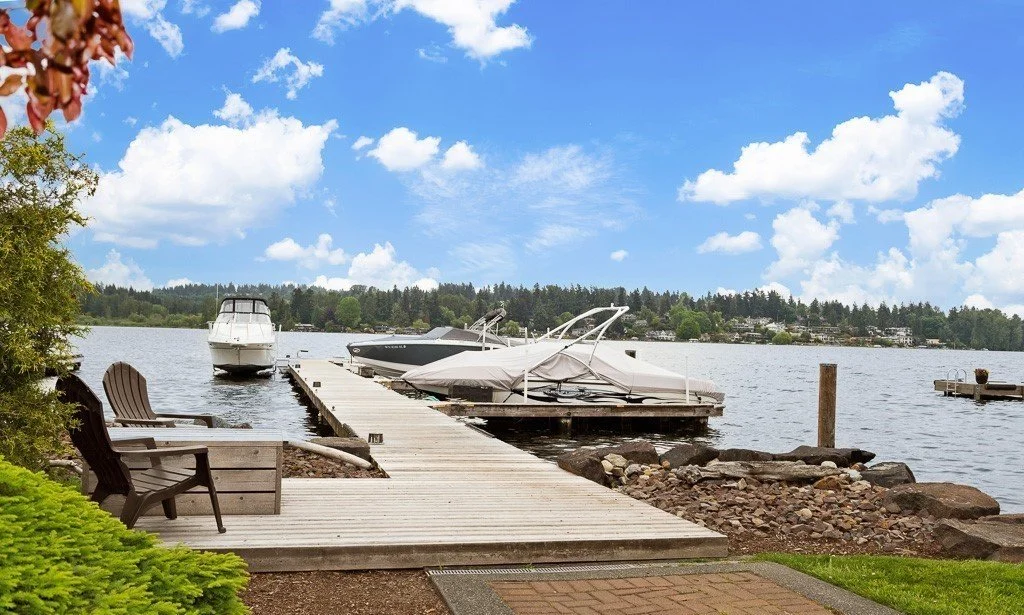
How Dock Access Varies by Eastside Market
| Market | Typical Access | Notes |
|---|---|---|
| Mercer Island | Mostly private docks | Low-bank Gold Coast lots common; premium reflects dock certainty |
| Bellevue | Mixed private/beach club | Meydenbauer Bay skews private; Enatai often beach-club based |
| Kirkland | Mixed | Moss Bay private docks common; Juanita often beach club |
| Medina & Four Points | Private docks standard | Large low-bank lots; dock access assumed at this price point |
| Lake Sammamish | Mostly private docks | Gradual-entry shoreline generally supports easier permitting |
General market patterns based on shoreline characteristics. Every property is different — always verify dock status and permit history for the specific lot, not the neighborhood in general.
The Due Diligence Checklist Before You Write an Offer
- Confirm whether the shoreline is low-bank, no-bank, or high-bank
- If a dock exists, verify it was actually permitted — not just built
- Request copies of any existing Army Corps, state, and local permits
- Ask whether the HOA or community has its own dock/moorage waitlist
- Review HOA financials, reserve studies, and special assessment history
- If you're planning new construction, budget realistic time — not just money — for the four-layer permitting process

Dock Rights & Permitting FAQ
Can you get a private dock on Lake Washington?
Yes, but dock rights depend on the specific property and waterfront type. Low-bank and no-bank waterfront typically allows private dock construction, while high-bank properties often require shared moorage or beach club access instead. Buyers need Army Corps of Engineers permits, Washington State shoreline permits, local building permits, and HOA approval where applicable.
How much does it cost to build a private dock on the Eastside?
Private dock installation on Eastside waterfront typically costs $50,000 to $200,000 or more, depending on dock size, materials, water depth, and permitting complexity. Properties with existing permitted docks carry a meaningful value premium since they eliminate years of permitting uncertainty for the buyer.
What's the difference between low-bank and high-bank waterfront?
Low-bank and no-bank waterfront sits at or near lake level, generally making private dock construction feasible. High-bank waterfront sits elevated above the shoreline and rarely permits private docks due to elevation challenges and environmental restrictions, making shared beach club or moorage access the more realistic option.
What are typical HOA and beach club fees for Eastside waterfront homes?
Basic waterfront HOAs with minimal amenities run $200 to $500 per month. Beach clubs offering swimming areas and boat moorage typically cost $500 to $1,200 per month. Luxury gated waterfront communities, such as those in Medina, can exceed $1,500 to $2,000 or more per month for extensive security, landscaping, and concierge services.
Which government agencies are involved in permitting a Lake Washington dock?
Building a new private dock on Lake Washington typically requires review from the U.S. Army Corps of Engineers, a Washington State shoreline permit, a local building permit from the relevant city, and HOA or community approval where applicable. Buyers should verify exact requirements with the relevant jurisdiction before assuming a lot supports new dock construction.
🏆 500+ Eastside Transactions · 🎓 CLHMS · CRS · ABR · GRI · CSP
⭐ 425 Magazine & Seattle Times Featured · 🌐 Bilingual English/Spanish

Dock Rights Aren't Something to Discover After Closing
I've walked dozens of Eastside buyers through exactly this due diligence — shoreline type, permit history, HOA reserve health — before they ever wrote an offer.
If waterfront access is non-negotiable for you, let's talk before you fall in love with a property that can't deliver it.
📞 (425) 941-8688 ·
✉ freddy@judahrealty.com
10237 Main Street, Bellevue, WA 98004